Building Quality into Parts with AI-Driven Vision-ML Inspection

Intelligently Driving Quality Production in Manufacturing
Discover how CLI’s physical AI-driven vision-ML detects non-conforming parts, delivers full traceability, and improves operational performance through customizable in-line inspection.
In high-volume manufacturing, even the smallest assembly variation can lead to costly rework, production delays, or customer impact. As part complexity increases and production schedules tighten, relying solely on manual inspection makes it difficult to consistently catch defects before they move downstream.
To address this challenge, Comprehensive Logistics (CLI) developed a proactive, scalable, vision machine-learning (ML) inspection platform that brings physical AI-driven quality verification directly to the production line. Physical AI refers to artificial intelligence systems that interact with the physical world, not just data on a screen.
The system detects non-conforming parts (wrong part, missing part, wrong positioning, etc.) in real time, preventing defective assemblies from advancing, and disabling equipment until issues are resolved. At the same time, the platform captures and retains full digital traceability at every step of the assembly process, providing customers with complete visibility and confidence in build quality.
Today, vision-ML is deployed in 50% of CLI facilities, supporting automotive and manufacturing customers with consistent, in-line quality verification that improves build accuracy, reduces disruption, and strengthens confidence in every part leaving the line.
The Challenge
CLI needed a solution capable of delivering real-time, scalable inspection to error-proof intricate part builds. Many quality risks involve small but critical variations — such as thread variation of approximately one-eighth inch on a screw or the presence of one versus two washers — details that are difficult to detect consistently in high-volume production environments, especially when relying on manual checks.
As production volumes increased and build complexity grew, manual checks alone could not provide the consistency, speed or traceability required to prevent defects from moving downstream.
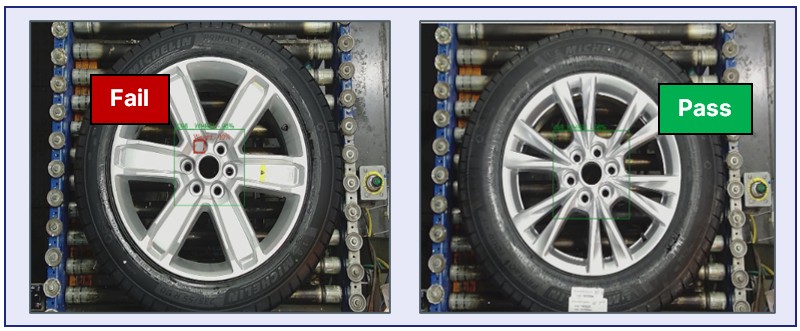
Can you find the difference in the photo below?
 |
 |
Even minor assembly variations can have a significant downstream impact. Vision-ML is designed to detect subtle differences that are easy to miss during manual inspection, ensuring consistent verification at production speed.
| Quality Challenge | Operational Impact |
|---|---|
| Missed defects | Human checks were inconsistent, subject to fatigue and sometimes skipped due to production pressures. |
| High cost of quality | Undetected defects resulted in rework, line disruptions and potential customer impact. |
| Limited scalability | Redundant manual audits across multiple stations were not consistently effective and reliable. |
| Lack of digital traceability | Manual processes could not reliably provide photo evidence, analytics, or searchable records to support root-cause analysis. |
Instead of relying solely on labor-intensive manual checks prone to human error variability, CLI’s vision-ML platform automatically inspects parts on the line, enabling consistent quality verification while maintaining production speed.
The Solution
At the core of CLI’s solution is a continuous learning quality cycle that includes onboarding, validation, retraining, monitoring, and human-in-the loop oversight. Vision-ML is built as a flexible, physical AI-driven quality platform that integrates seamlessly into diverse plant environments and enterprise systems, including WMS/STREME, MES, PLCs, and SCADA applications.
By combining traditional rule-based vision inspection with machine learning and final human verification, CLI ensures every part meets quality standards before leaving the line. Each layer plays a defined role in maintaining accuracy and reliability:
| CLI ensures every part meets quality standards before leaving the line by integrating traditional and ML vision systems with final human verification to check quality. | ||
|---|---|---|
 PLC Integration: Traditional rule-based vision systems use multiple pre-programmed inspection tools to validate part quality. |
 MES Integration: The Vision-ML system continuously learns from production data to detect anomalies and pinpoint failure locations. |
 Human Verification: Operators provide final oversight, reinforcing system accuracy and ensuring quality decisions reflect real-world production conditions. |
The result is a collaborative approach in which machine learning intelligence and human insight work together to support zero-defect manufacturing.
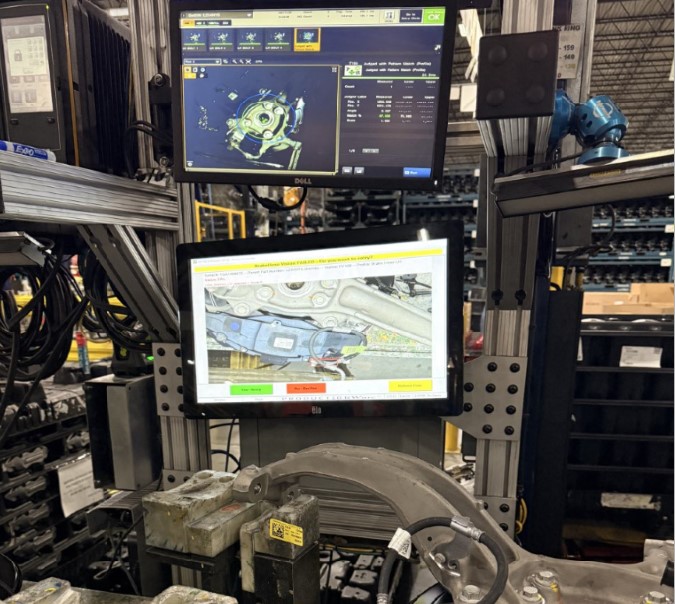
Once a part is evaluated, Vision-ML sends the inspection result directly to the MES, where it is programmed to block defective parts from moving forward. Failed inspections automatically prevent parts from advancing, visually identifying the issue on the operator interface and requiring corrective action before production can continue. Quality enforcement becomes automatic rather than dependent on manual intervention.
All builds are logged for full digital traceability and reporting. Image capture, inspection results, and production data are retained to support audits, analytics, and root-cause analysis. This ensures that quality decisions are enforced automatically rather than left to manual intervention.
By combining real-time image capture with continuously trained AI models, vision-ML improves over time. The system is “taught” and “learns” from production data and steadily improves its ability to detect and distinguish between conforming/non-conforming parts before they move downstream. This process ensures models do not remain static — they evolve alongside production, adapting to variation and strengthening detection accuracy as new data is introduced, making the system smarter every day.
In addition to vision-based inspection, CLI supports hybrid quality processes where OCR technology captures part and label data and transmits it directly to MES, reducing manual data entry while maintaining consistent traceability.
| Quality Challenge | Operational Impact | Vision-ML Solution |
|---|---|---|
| Missed defects | Human checks were inconsistent, subject to fatigue and sometimes skipped due to production pressures. | Automated, in-line inspection evaluates every part consistently using trained AI models. |
| High cost of quality | Undetected defects resulted in rework, line disruptions and potential customer impact. | Defects are detected immediately, preventing non-conforming parts from moving downstream and reducing rework. |
| Limited scalability | Redundant manual audits across multiple stations were not consistently effective and reliable. | Scalable platform deploys across multiple locations with centralized model management and reporting. |
| Lack of digital traceability | Manual processes could not reliably provide photo evidence, analytics, or searchable records to support root-cause analysis. | Image-based inspection records, performance dashboards and full traceability support audits and continuous improvement. |
The Results
By embedding vision-ML directly into production workflows, CLI has achieved meaningful improvements in quality, performance, and operational stability across multiple manufacturing environments. Inspection results and quality data flow directly into production and reporting systems, enabling real-time decision-making without disrupting operations while improving audit readiness and compliance outcomes too.
Key outcomes include:
- Greater process visibility through granular insights into which components and assembly steps fail most often, enabling targeted process improvements.
- Reduced operator dependency by standardizing inspection criteria within the AI system, lowering the risk of newly trained operator errors and simplifying cross-training.
- Faster root-cause resolution by linking recurring issues to specific lines, stations, or shifts, reducing time to corrective action.
- Improved build consistency by removing variability associated with manual inspection processes.
- Complete traceability with every image, inspection decision, and exception stored for audit, reporting, and compliance review.
- Improved labor utilization as AI handles repetitive inspection tasks, allowing team members to focus on problem-solving and higher-value activities.
Together, these improvements help stabilize production, reduce related disruptions, and support continuous improvement initiatives across CLI operations and customer programs.
The Future Outlook
CLI continues to evolve Vision-ML into a flexible AI-driven quality platform designed to adapt to new parts, production lines, and plant environments with minimal re-engineering. The long-term objective is a sustainable system that delivers proactive alerts, and deep integration into production workflows, allowing quality risks to be identified and addressed before they impact operations.
 |
 |
Future use cases include advanced defect classification, predictive maintenance signals, and supplier quality monitoring. These capabilities will enable operations teams to detect patterns earlier, reduce variability across the supply chain, and resolve potential issues before they reach the production line.
By positioning CLI as a leader in AI-enabled quality and error-proofing, vision-ML is not just checking parts. It is building a continuously learning platform that scales with production, strengthens operational resilience, and supports long-term manufacturing excellence.
Let’s talk about your quality challenges.
If you are exploring ways to improve inspection, traceability or production stability, our team is ready to listen and help evaluate your options.